How to choose the right driving instructor
What to look for, and the questions worth asking before you book.
 By Geoff Newman, driving instructor in Sevenoaks
You might imagine that being a former racing driver makes me a better driving instructor because I know how to drive a car very quickly.
It does help — although perhaps not for the reasons you might expect.
Before I became a successful racing driver, I first had to learn how to become one. And, looking back, I think that experience has had a profound influence on the way I now teach people to drive.
When I started racing, I already knew how to drive. What I didn't know was how to drive a racing car properly.
Suddenly, I was learning an entirely new set of skills: car control, balance, braking techniques, racing lines, weight transfer and how to understand what a car was doing underneath me. I had to process enormous amounts of information while travelling at speeds that gave me very little time to think about any of it.
And I wasn't immediately good at it.
I don't mind admitting that there were times when I was screaming — literally and metaphorically — around a racetrack, desperately trying to improve. Sometimes I felt hopeless. Occasionally I spun off the circuit. Frequently I wondered why something that appeared so simple when somebody else did it felt so incredibly difficult when I tried it myself.
That experience gave me something extremely valuable as a driving instructor: I remember what it feels like not to be able to do something.
One of the people who played an important part in my development was my race coach, Darren Burke.
Darren would sometimes tell me the same thing over and over again. I heard what he was saying. I thought I understood it. And yet I wasn't necessarily able to translate those words into what I actually did behind the wheel.
Then, sometimes much later, something would suddenly click.
Darren hadn't necessarily changed the advice. What had changed was me.
I'd accumulated enough experience to give his words context. Something that had previously been an abstract instruction suddenly connected with what I was feeling through the car and seeing on the track.
I see exactly the same thing with learner drivers.
I can explain something to a pupil on their third lesson and they may appear to understand it perfectly. Ten lessons later, I might explain precisely the same thing and they'll say, "Oh! Now I understand what you mean."
They weren't stupid the first time. They weren't ignoring me. They simply didn't yet have enough experience for the information to mean very much.
That distinction is incredibly important.
It's one of the reasons I'm patient when I teach.
If a pupil hasn't understood something after I've explained it several times, repeatedly giving them exactly the same explanation — only louder — isn't particularly useful.
Sometimes they need more experience. Sometimes they need to make the mistake themselves and understand its consequences. And sometimes it's my responsibility as the instructor to find a completely different way of explaining it.
That's something I learnt from watching Darren at work: how you explain something matters just as much as what you explain. The right words, at the right moment, in the right order, can turn a confusing instruction into something that suddenly makes sense.
Learning isn't always a neat, linear process.
There are breakthroughs, plateaus and occasional backward steps. Something that felt impossible last week can suddenly feel completely natural this week. Racing taught me to trust that process.
It also taught me to be a little more compassionate towards the person sitting in the driver's seat.
As my racing developed, another interesting change took place.
At first, I needed somebody to tell me what to do. As I became more experienced, good coaching became less about instruction and more about helping me analyse my own performance.
Why did that corner go wrong? What did I notice? What could I have done differently? What am I going to try on the next lap?
That's very similar to the way I teach learner drivers.
Initially, I might provide quite a lot of instruction. As someone's skills and experience develop, I increasingly move towards coaching: asking questions, encouraging them to assess situations themselves and helping them develop their own judgement.
Eventually, my job is to say very little at all.
After all, the purpose of a driving lesson isn't to create somebody who can drive brilliantly while a driving instructor is sitting beside them. It's to create somebody who can make good decisions when I'm no longer there.
There was another enormously important part of learning to race that I still use in my teaching today: video analysis.
When you're actually driving, you're in the middle of the experience. You're concentrating, reacting and dealing with whatever is happening in front of you. In racing, everything happens extraordinarily quickly. But even at normal road speeds, a learner can have an enormous amount of information to process in just a few seconds.
When you watch the same event back on video, something changes.
Suddenly, you're no longer the person desperately trying to deal with the situation. You're almost a dispassionate observer.
You can pause it. You can rewind it. You can watch the same five seconds several times. You can look at where the car was positioned, where somebody was looking, what another road user was doing and what clues were available before the situation developed.
Most importantly, you have time to think.
I found that incredibly powerful when I was racing, and it's one of the reasons video has become such an important part of the way I teach people to drive.
There is a huge difference between explaining a situation to somebody and allowing them to see it unfold.
I could tell a learner, for example, that if a pedestrian has already stepped into the road ahead of them, they may need to stop if it is safe to do so.
That's useful information.
But now imagine watching a real example.
We can see the pedestrian approaching. We can pause the video and ask: What have you noticed? What might happen next?
We can let the video continue.
The pedestrian steps into the road.
Now we can look at how the driver reacts. Did they notice early enough? Did they anticipate what might happen? Did they come off the accelerator? Did they check their mirrors? Was braking necessary? What options did they have?
A situation that might have lasted only a few seconds has become a learning exercise that we can explore for several minutes.
And that learning doesn't have to be limited to the person who originally experienced it.
This is another aspect of video analysis that I particularly value.
A learner doesn't have to make every mistake personally in order to learn from it.
Where appropriate, I can use examples of situations that have occurred during previous lessons to help another pupil understand what might happen to them. Any footage I use is always anonymised, so nobody is ever identified.
They can watch another driver approach a difficult roundabout, deal with a pedestrian, misjudge a gap or encounter an unexpected situation and ask themselves: What would I have done?
That gives them something extraordinarily valuable: experience without having to experience everything first-hand.
Of course, watching a video can never replace actually driving a car. But it can help accelerate the process of building understanding.
It's also much easier to discuss somebody else's mistake objectively. There isn't the embarrassment of thinking, "I've just got that wrong." Instead, we can simply analyse what happened, why it happened and what might have worked better.
Then, when something similar happens on the road, it isn't entirely new.
They've already seen it.
Motor racing also taught me the importance of surrounding yourself with the right people and the right equipment.
When I raced, I wanted excellent coaches and equipment that allowed me to concentrate on improving my driving rather than fighting unnecessary problems.
I've carried that philosophy into my driving school.
It's one of the reasons I deliberately chose a Volkswagen Polo as my manual tuition car. A learner already has an enormous amount to think about. They don't need a car that makes clutch control, steering or manoeuvring unnecessarily difficult.
The car shouldn't be another obstacle to overcome. It should make learning easier.
The same principle applies to teaching. A good instructor, like a good racing coach, should be reducing unnecessary difficulty so that the learner can concentrate on the skill they're actually trying to develop.
Of course, there are technical benefits too.
Motor racing teaches you an enormous amount about what a car can — and cannot — do. You develop a much deeper understanding of grip, balance, braking, steering, weight transfer and the consequences of different inputs.
Perhaps surprisingly, racing also teaches smoothness.
The fastest driver isn't necessarily the person making the most dramatic movements. Good driving is controlled, deliberate and planned. Looking further ahead gives you more time. Smooth inputs keep the car balanced. Good observation allows you to anticipate rather than react.
Those principles are every bit as relevant at 30 mph in Sevenoaks as they are on a racetrack.
But I don't teach learner drivers to drive like racing drivers.
Quite the opposite.
I use what racing taught me about car control, observation and anticipation to help people become calmer, smoother and safer road drivers.
There's one more benefit, and it matters most to the person in the driver's seat.
Because I'm used to taking in information and making decisions at racing speeds, a 30 mph road in Sevenoaks leaves me with plenty of spare attention.
That means I can watch the road ahead, the traffic around us and everything you're doing, all at the same time. I can spot a situation developing early, usually long before I'd ever need to use the dual controls, and help you deal with it calmly.
It also leaves me free to concentrate on teaching: noticing what you're finding difficult, and working out the best way to explain it.
I eventually became a successful racing driver, winning championships and racing in the UK and Europe.
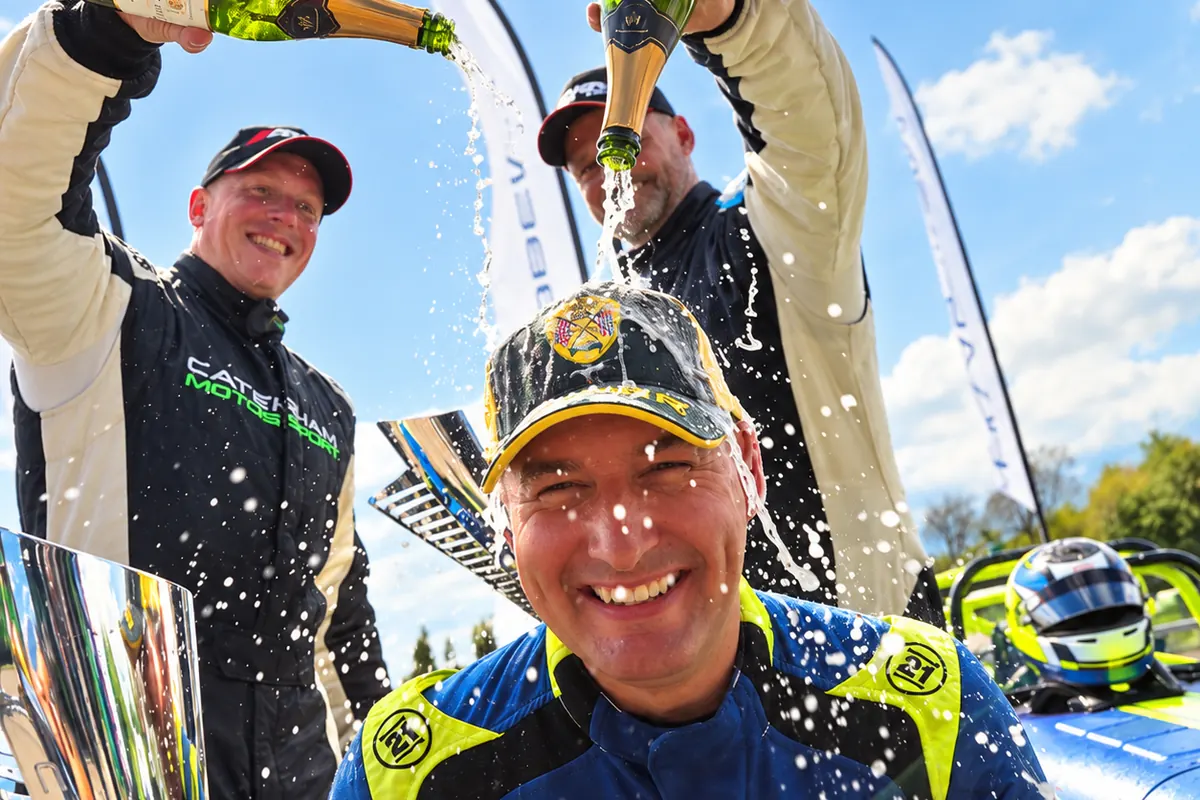
I'm proud of that. But when it comes to teaching somebody who is nervously approaching a roundabout for the first time, the trophies aren't the most useful part of that experience.
The useful part is remembering the person I was before them.
The person who couldn't quite get it right. Who made mistakes. Who became frustrated. Who needed Darren to tell him the same thing more than once. Who sometimes heard what a coach was saying without really understanding it.
And who discovered the enormous value of being able to go back afterwards, watch what had happened and learn from it without the pressure and emotion of actually being behind the wheel.
Eventually, with good coaching, good equipment, patience, analysis and enough experience, things that once seemed impossibly difficult gradually became second nature.
That's probably the most important thing motor racing taught me about being a driving instructor:
Never forget what it felt like to be the learner.
What to look for, and the questions worth asking before you book.
How to help between lessons, calmly and safely.
What a mock test involves, and why it helps on the day.
I'm Geoff Newman, a patient, calm driving instructor, born and raised in Sevenoaks. I taught my own sons to drive, and 87% of my learners' driving tests passed in 2026.
Tell me a little about the learner and when you'd like to start, and I'll get back to you.
Please note I don't hire out my car for tests, take people to test without lessons, or offer short-notice lessons.
Prefer email or WhatsApp?
No pressure, no obligations, just to see if we're a good fit.