Driving test manoeuvres in Sevenoaks
The four manoeuvres, the car parks examiners use, and what happens if you get an emergency stop.
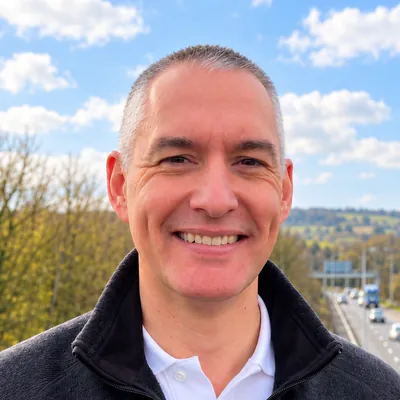 By Geoff Newman, driving instructor in Sevenoaks
Updated
You'll be asked to do one of three reversing manoeuvres, and you won't know which in advance, so be ready for all of them. General questions come first, then each manoeuvre in turn.
Yes, both are allowed. But the examiner is assessing your observation, control and judgement, not just where the car ends up. Use the camera as an aid, not instead of looking all around. A perfectly placed car won't make up for missing observation.
It's hard to. I once sat in on a test where the examiner described a learner's manoeuvre as "terminally slow" in the debrief, and didn't record a fault. I'm not recommending you aim for that, but slow, careful and well-observed is exactly what examiners like to see. There's no prize for finishing quickly.
No. Let the examiner finish the whole instruction. They need to give it in full for the test to be fair, and the manoeuvre you're expecting isn't always the one you get: bay parks can be forwards or in reverse, on the left or the right.
Learners who've done plenty of mock tests sometimes reach for the controls mid-sentence. Instead, listen to the end, take a breath, and then begin.
Keep your observation going all around, but try not to make eye contact with anyone who's making you feel pressured. Catching the eye of a waiting driver or someone on the pavement makes you feel judged, and the natural reaction is to hurry, which is when observation slips and control suffers.
You can know exactly where someone is without locking eyes with them. Be aware of other road users, but never let them rush you.
Because examiners often wait for you to do it before moving on, and they won't always prompt you. After a manoeuvre, pulling up on the left or an emergency stop, put the parking brake on and take the car out of gear (or select Park in many automatics).
If the examiner says "thank you" straight after a manoeuvre, that's often your cue. Doing it automatically avoids awkward silences, and in a manual it lets your clutch leg relax too.
The turn in the road (the three-point turn) and reversing round a corner were both taken out of the car test in December 2017. Reversing round a corner was seen as more relevant to van drivers. The turn in the road went because bay parking checks the same skills just as well: slow control, accurate steering and good all-round observation.
Instead, you'll be asked to do one of these:
It's still worth learning to turn the car round in a narrow road, though. You'll need to do it at some point once you've passed.
Several, depending on the time of day; later on many get too busy to be practical. Ones commonly used include:
If you practise at the station long stay or Miller & Carter, pay for parking or you may be fined. Lidl has a 90-minute limit. Please be considerate to other drivers wherever you practise.
Because many Sevenoaks car parks were built when cars were much narrower. The Stag Theatre/South Park Car Park, for example, has diagonal bays and tight rows. If you've only practised in wide supermarket spaces, these can be a surprise. Practise in the older, tighter car parks so they feel normal on the day.
Practise turning left or right into a bay, because that's what you'll be asked to do; don't just drive straight into an empty space ahead of you. Be ready to drive in forwards or reverse in, on either side.
If you're asked to drive in forwards, remember it's still a reversing manoeuvre: the examiner will be watching how carefully you reverse out, with full observation, and you'll need another good look all around when you change direction to drive on.
As easy as you make it. The biggest thing you can do is drive into the car park slowly. That gives you time to look around, pick your bay and plan how you'll get into it.
In my experience, examiners very often look for a bay with empty spaces either side, so in effect you have three bays to aim for. If you'd rather park next to another car, that's up to you, but picking a bay with space around it won't count against you. Keep your observation going all the way in.
There's no national speed limit in car parks, and I've never seen an examiner bothered by someone going slightly over a 5 mph sign. What matters is a slow, safe speed for the situation, with cars pulling in and out and pedestrians everywhere. Driving slowly also gives you time to look, plan and position the car.
Yes. You don't need the examiner's permission. When you finish, the examiner may ask "Are you happy where you've finished?" It isn't a trick question; it's your chance to check.
Secure the car first, then open the door and look. If you still can't tell, switch off the engine, take off your seatbelt and get out. Then:
You're allowed to cross white lines on the way in and out. Keep up full observation while correcting, and don't rush because you feel watched.
Not in my experience. On over 120 Sevenoaks tests, I've only ever seen the parallel park done behind a single car, and only on the left.
Listen to the instruction: you'll be asked to finish within about two car lengths of the car you've parked behind. That's a limit, not a distance to cover, so if you're parked neatly sooner, you're finished. A common mistake is completing the park and then reversing back further for no reason. Look all around throughout, keep your speed down and secure the car when you're done.
The examiner asks you to pull up on the right-hand side of the road when it's safe, then reverse about two car lengths before rejoining the traffic. My recommended method:
Splitting the reverse in two gives you a natural moment to recheck everything. Take real care moving off, as you're rejoining traffic from an unusual position.
Yes: make sure the car and the steering wheel are both straight before you finish pulling up. Then all you have to do is reverse in a straight line.
Many learners think that once they've crossed to the right, they have to stop wherever the car ends up. You don't. Creep forward a little more until everything is straight, then stop. A few extra seconds on the set-up saves a lot of correcting later.
Not checking the mirrors while reversing. Learners fixate on getting exactly two car lengths and forget to look. The instruction says approximately two car lengths, so the examiner isn't measuring to the inch.
Keep switching between your side mirrors while you reverse, so you always know what's happening around the car. Stopping a little short or long is minor; missing a hazard isn't.
The four manoeuvres, the car parks examiners use, and what happens if you get an emergency stop.
Morleys Roundabout, the Otford duck pond, Riverhead, the narrow lanes and more places that catch learners out.
What a mock test involves, and why it helps on the day.
I'm Geoff Newman, a patient, calm driving instructor, born and raised in Sevenoaks, where I teach manual and automatic driving lessons in Sevenoaks. I'm the author of Sevenoaks Driving Test Secrets and a series of narrated videos that help learner drivers understand the Sevenoaks test routes. I taught my own sons to drive, and 87% of my learners' driving tests passed in 2026.
Tell me a little about the learner and when you'd like to start, and I'll get back to you.
Prefer email or WhatsApp?
No pressure, no obligations, just to see if we're a good fit.